Showing posts with label equipment. Show all posts

Wednesday, 30 May 2012

Scything

A bit tidier
I'd been wondering whether to borrow a lawnmower from one of the neighbours, but I left it too long and the grass shot up to knee-height. So I borrowed a scythe, and mowed the larger patches of grass the old-fashioned way. Good exercise, that.

This produced enough grass cuttings to fill up the compost bin, when mixed with six or seven scrunched up newspapers. I will urinate on the compost heap when I remember, to add a bit of phosphorus and nitrogen. 

Monday, 26 March 2012

Window box for parsley

Window box for parsley
This window box was in place when I moved to this house, so I tipped the old soil and dead plants on to the compost heap and filled it with fresh earth from the garden. I mixed in the last of a bag of potting compost into the top inch or so, and added a packet of parsley seeds.

I also planted out the first batch of leeks into gaps in the garlic (bed seven). I planted the garlic cloves much too far apart, and I hope the leeks will be OK in between them. I found that using two trowels facing each other produced very neat holes, just the right size for the paper pots, so I will not bother making another transplanting tool.

Sunday, 25 March 2012

Vegetables!

Another major planting session today:
Bed eight: a row of peas (the last of the Greenshaft) and another row of spring onions (despite the fact that the first row hasn't appeared yet, after just over three weeks.)
Bed five: another row of carrots - half Nepal F1 and half Early Nantes. I think the Nepal ones in the first row are just starting to show, but they could be grass at this stage. I'm planning to plant four rows in this bed at monthly intervals, to get a continuous crop, which means that row four isn't going to be planted for ages - I put some radishes in that space, which will have come and gone by the time I want it for the last sowing of carrots.
Bed zero: On the same principal, I filled a space earmarked for courgettes with a direct sowing of a row of spinach (Samich F1).
In the salad bed, bed ten, I planted out the two pak choi from the first batch which germinated, leaving the rest of the row for the second batch. I also sowed a row of Little Gem lettuce, and three rows of mixed salad leaf seeds - mizuna, chicory, corn salad, rocket, and texsei. (I don't know what all of those are, hope I like them!)
Lastly, I put two tomato seeds in each of six pots - I'll keep whichever is the strongest plant in each one, before planting them out.

Then I tested my newest bit of garden equipment - a hammock. Great!

Update: Corn salad is the same thing as lamb's lettuce! So I'll have tons of that if it all comes up. 

Monday, 19 March 2012

Planting out

Planting out turnip seedlings
Today I planted out a lot of the paper pots - cabbage 'greyhound' and cauliflower 'All Year Round' into bed eleven (and two spare cauliflowers in gaps in the kale bed). Bed five is turning into a collection of small numbers of different plants - there is some surviving land cress and two lamb's lettuces from the autumn planting, and six broad beans (one now showing leaves) planted as replacements for the dead ones in bed one. In the spaces left by these, I've now planted eight turnips, six beetroots, and five spinach plants.

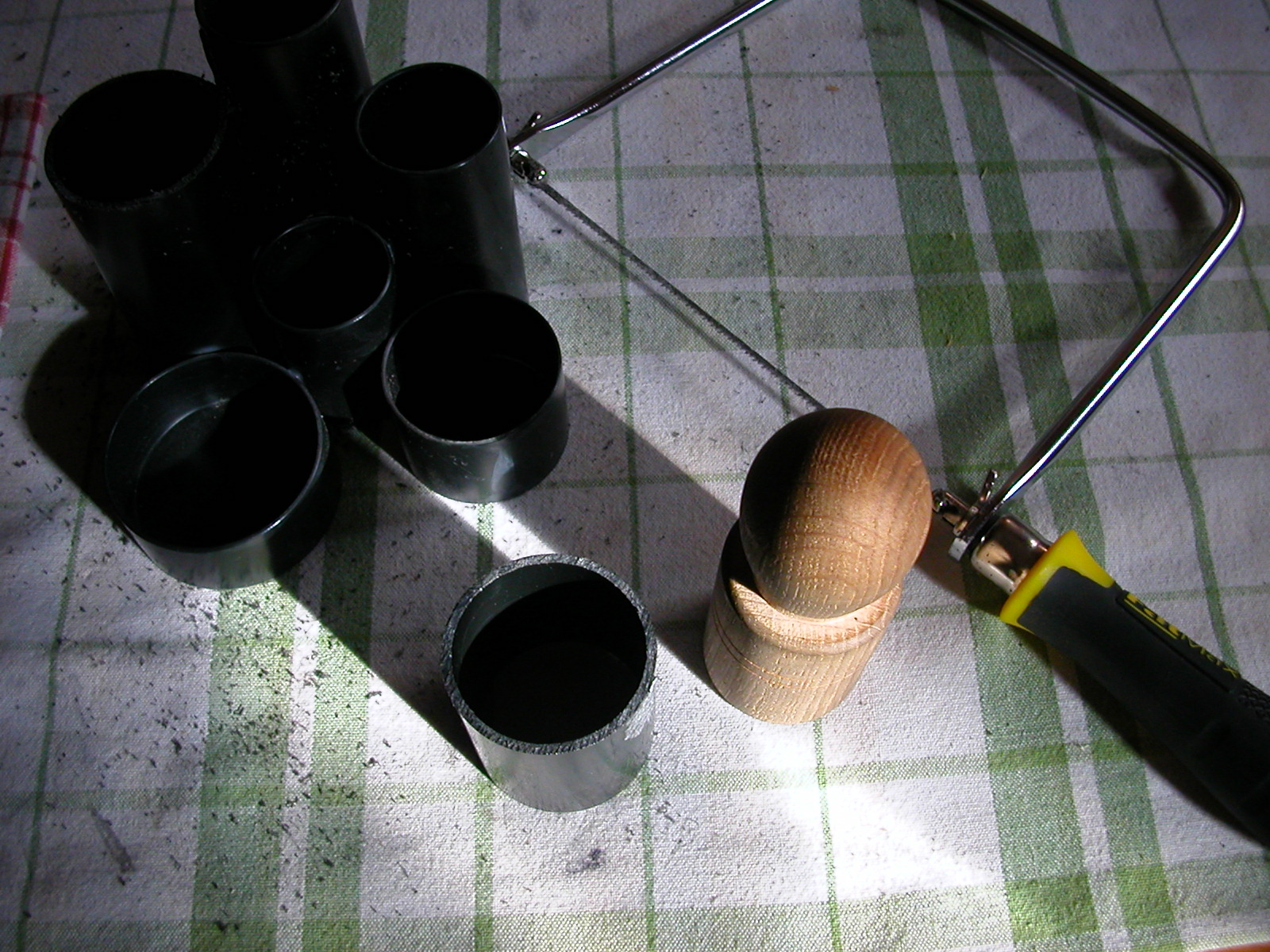
All this planting was done using the transplanter I made, which worked better than I expected. I thought that the soil might not be lifted out of the hole, but it came up in neat little plugs leaving cylindrical holes of the right size. Unfortunately the plastic was too brittle to take the load, and after making about thirty holes it broke up. I'll call it a successful prototype, and think about making a more robust one out of metal. It would also be better if the handle was in line with the axis of the barrel. Hmmm.

Saturday, 17 March 2012

Home made transplanter

Making transplanter
Finished article
I checked and some of the paper pots with the larger seedlings have now got roots poking out of the bottom. They need to be transplanted soon, so I made a transplanter out of an unused desk-tidy. I hope I can make holes just the right size with it.

Sunday night is predicted to be cold, 2ºC, and milder weather is forecast for next week, so I will plant them out on Monday.

Growth notes: the buds on the apple tree have started to open, and the radishes planted out in bed eight are now visible. The transplanted peas are growing well, but there is as yet no sign of the directly sown carrots, peas, and spring onions.

Wednesday, 7 March 2012

More seedlings appear

Beetroot seedlings - 'Chioggia Pink'
Three beetroot seedlings, and one spinachseedling have appeared now. Ten leeks are visible (which is great - I love leeks!). Peas, cauliflowers, turnips, and cabbage are growing well. Still no sign of the basil or broad beans. I'll give the (probably dead) peas in bed one another couple of weeks to show signs of life, and if there are none I will plant the potted peas there. If the existing peas recover, I'll put the potted ones along the back of bed eight. By the end of March, the weather should be good enough for all the pots to go into the soil, although I haven't worked out where they're all going to fit in yet. Then I will start more growing in pots.

The pots do dry out fairly quickly, but I'm watering them when they seem to need it with a mist-spray bottle.

Thursday, 16 February 2012

Busy morning

Making paper pots
First batch - leeks, cauliflowers, and two varieties of peas
Since the weather is very mild at the moment, and the long-term forecast says it will probably continue mild, I decided to try getting some veg off to an early start. I chose things that are supposed to be planted in March, and will keep them in the greenhouse for the first month or two. The veg chosen for this early experiment are leeks (Carlton F1), cauliflowers (All the Year Round), and two varieties of peas (Early Onward and Greenshaft).

For Christmas I got a wooden tool for making biodegradable pots out of newspaper, pictured right. A strip of newspaper about 4" wide is wrapped round the top part with about 1.5" sticking out, which is folded under and crushed against the bottom part of the tool.

They seem to stay together quite well. Obviously they won't be very strong when wet, but I will be able to leave them in their trays until it's time to plant them out, when the pots will be transferred whole to the beds - no need to unwrap them, the newspaper will just decompose in the ground.

Since the volume of earth in each is quite small, and the paper will wick water away, there may be problems with them drying out. Time will tell.

Raspberry plant
I also planted out the raspberry I got from the neighbours. I put plenty of slow-release fertilizer pellets in the hole, to help it along.

Some raspberry varieties produce fruit on the new year's growth, and some on year-old wood - if mine is the latter I wont see any raspberries until 2013. Hope it's the former!

Monday, 6 February 2012

Leaf blowers = evil

Spring-tine rake. Low-tech and effective.
This is a miscellaneous rant, because there's not much to do in the garden at the moment. It's been too frosty recently, and there's now a couple of inches of snow over everything.

So, compare two instruments for sweeping up fallen leaves. The old-fashioned spring-tine rake, and the electric or petrol-driven leaf blower. I believe that the differences in these two tools illustrate many of the serious errors in our society's attitudes towards the environment, sustainability and human labour which are quite likely to lead to the collapse of civilisation.

The technology for making a rake has been around for about 3000 years, when wire was invented. Rows of wires are supported by a simple frame - pieces of metal with holes in them, also very low-tech, and attached to a stick - possibly the lowest technology tool there is. Rakes are simple, easy to produce and use, robust, and effective. Leaf blowers are constructed from dozens of plastic and metal parts, all of which are precision engineered, which has a high environmental cost. They cannot be made using simple metal- and wood-working skills, and all but the simplest repairs will require new parts sourced from the original manufacturer.

The first point of comparison is clearly in the rake's favour in terms of the environmental impact of construction, use, and maintainance.

The second point of comparison is in use - they do similar, but not identical tasks. The aim of each is to move leaves off lawns, but the action of the rake draws leaves towards the user, resulting in a pile which can be easily taken up and put in a wheelbarrow to take to the compost heap, or into sacks for rotting down as leafmold. The leaf blower blows leaves away from the user, and it is less easy, if not impossible, to make a tidy heap of leaves using one. Leaves are transformed into litter, to be whooshed away onto someone else's property, or the public street. By using a conceptually poor tool, a valuable resource is turned into a problem.

Bosch leaf blower. Worse in every respect.
Thirdly, the leaf-blower panders to the dangerous delusion of convenience - the idea that anything that reduces the expenditure of human muscular energy is a good thing, almost irrespective of the cost. In this case, the cost is in far higher environmental impact, and the transformation of a resource into a disposal problem. This is not worth paying for the highly questionable benefit of reducing the gentle exercise involved in raking to mere ambling about holding a gizmo.

Developing leaf blowers was thus a totally misguided project, giving a higher environmental cost, to do a worse job, of less benefit to the user and the land so managed.

Tuesday, 8 November 2011

Leaf mold

Making Leaf mold
I gathered together the fallen leaves from under the cherry and apple trees, and bagged them up into bin liners. The weather has been very wet recently, and the soggy leaves will rot down in a year or two to make a fine soil improver called leaf mold. The leaves directly under the cherry were still dry, so I moved them onto the grass to get wet, and I will bag them in a couple of days.

This was brought on by today's purchase of a spring rake. £2.99, made in China. It has a slightly flimsy feel, but worked well enough.

Monday, 17 October 2011

Greenhouse

I took advantage of an end-of-season sale, and got this small plastic greenhouse for £17.

At the top, a small raspberry plant, the next shelf down is occupied by the herbs, and at the bottom are three chilli plants and a bag of compost.

The nights are getting colder now, and I hope this will be enough protection for the herbs over the winter.

In the garden, the rye in bed four doesn't seem to be growing, and the cabbage seedlings look a bit forlorn too. More broad bean shoots are poking out now, however.

Friday, 7 October 2011

Modified plan

Bed one now has 60 peas in two rows, and I've planted cabbage seeds in half of bed three. Having done that, I realised that 6' x 6' is too wide, and it is going to be difficult to get to the plants in the middle.

I've modified the plan for the higher area, beds five to eight, and I am going to make them only 4' wide. I'm also going to leave a small path in the middle to make access easier, so the new plan looks like this. Having a path between beds six and seven also means that I can grade and plant five and six before having to dig the last two, which is good because I have some Japanese onions and garlic which I want to put in soon.

Yesterday I bought a soil sieve, which speeds up the stone removal process, and leaves a lovely fine tilth, which will be good for the alliums and also for carrots.

Another job done today was removing the large sapling near bed one - I thought it was a maple, but in fact it was a sycamore. I was thinking of planting a hazelnut tree there, but reading up on them I find that they are self-infertile, so I would need two. There are also a lot of squirrels in the neighbourhood, so it might be a lot of money and effort with no crop to show for it. This part of the plan requires further thought, but there's no hurry - I don't think this is the right time of year for planting new trees.